How to Set Up a Webhook Dead-Letter Queue and Never Lose an API Payload Again
Modern business operations rely heavily on connected systems. Whether you are syncing e-commerce orders to an ERP, passing lead forms from your website into a CRM, or triggering automated customer notifications via chat APIs, webhooks are the invisible glue holding your tech stack together. But what happens when that glue temporarily snaps?
If your systems lack proper error handling, a brief server timeout, a malformed JSON payload, or a sudden third-party maintenance window can cause a webhook to fail. In many default setups, that request simply drops into the ether. No error log, no notification, just missing data that you only discover days later when a client complains.
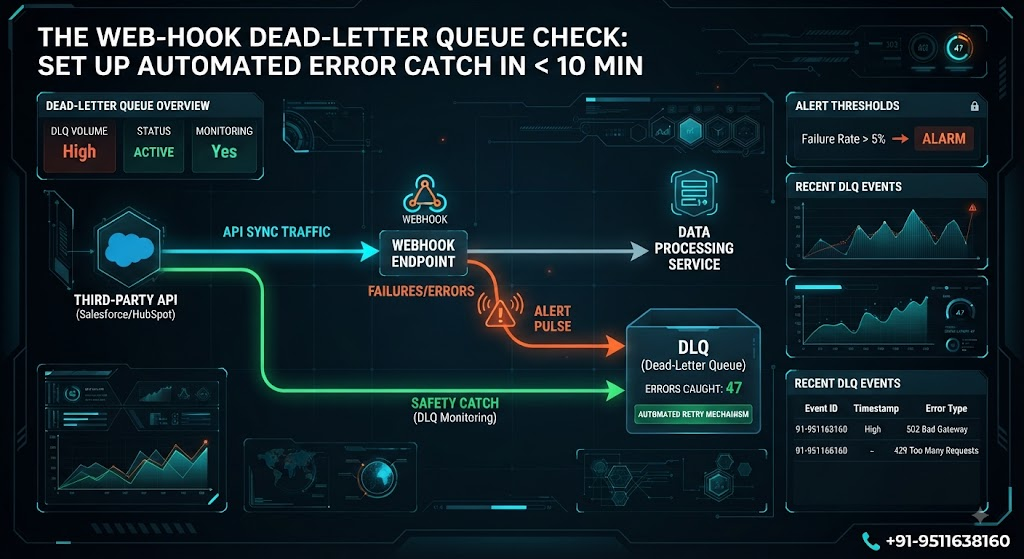
Implementing a Dead-Letter Queue
To solve this, engineering teams use a pattern known as a Dead-Letter Queue (DLQ). You do not need an enterprise cloud budget to implement a basic version of this safety net. Here is a quick, actionable blueprint you can ask your developer to set up today.
- Catch Non-200 Responses
When your server receives a webhook or attempts to dispatch an outbound API call, wrap your execution block in try-catch logic. If the receiving endpoint returns an HTTP status code outside the 200–299 success range, do not let the error pass silently.
- Log the Payload Locally
Instead of discarding the failed request, write the raw payload, headers, timestamp, and target endpoint into a dedicated fallback database table or flat-file log. This preserves the exact state of the transaction at the moment of failure.
- Trigger an Actionable Alert
Storage alone is not enough; you need visibility. Configure a secondary lightweight script to send an instant notification to your team channel (via Telegram, Slack, or email) whenever a new entry hits the DLQ table. Include a quick retry button if appropriate.
Build Robust Systems Faster
Proactive error handling is the difference between a fragile script and production-grade software. At D&D Technology, we build custom applications, CRMs, ERPs, and automated workflows with built-in fault tolerance, ensuring your business data remains secure and synchronized 24/7.
Need custom software or bulletproof integrations built for your business in India or Bangkok? Reach out to D&D Technology today and let us take your workflow from concept to deployment in just 24 to 48 hours.
📞 +91-7296994920


Discussion0