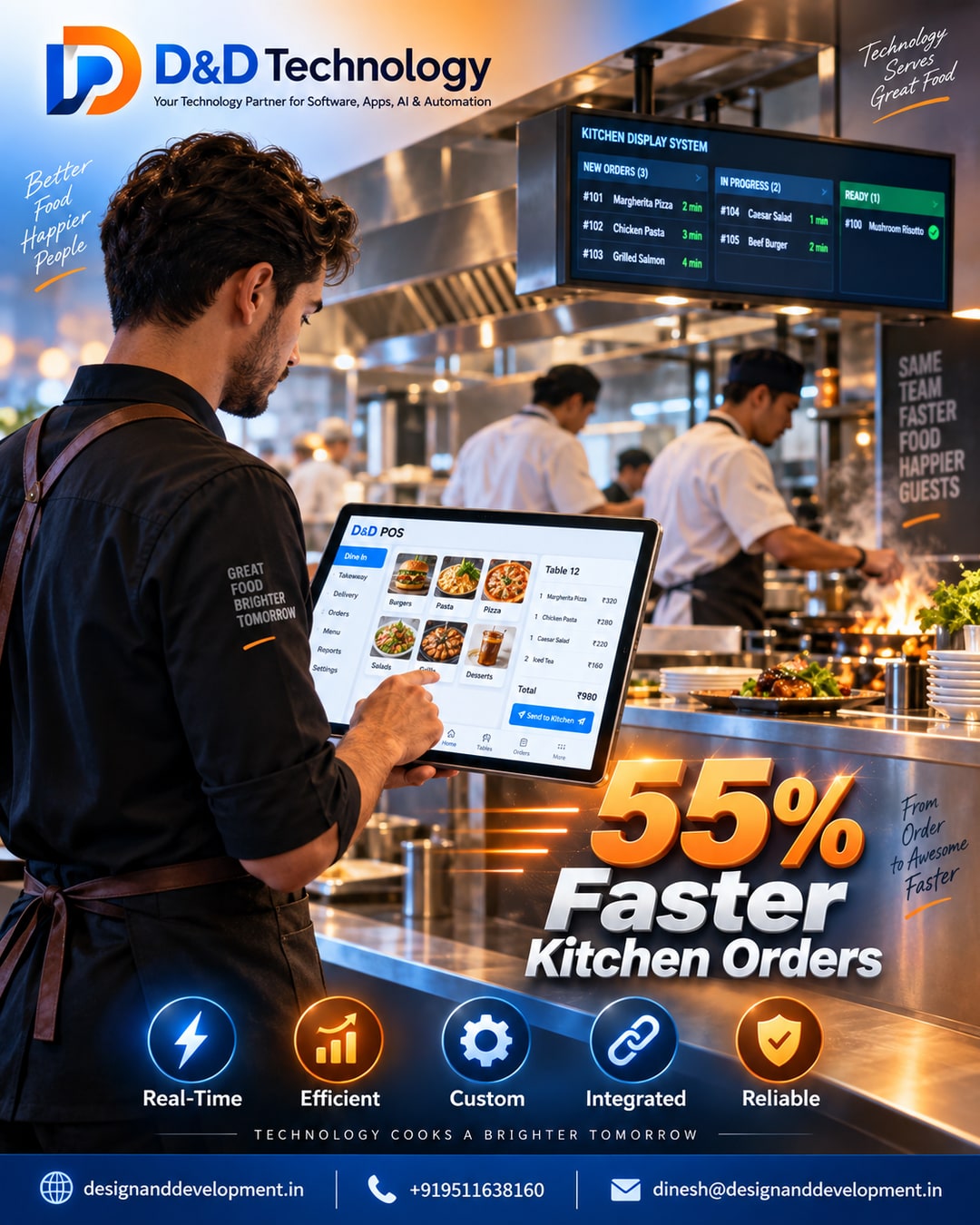
How a Restaurant Chain Cut Order-to-Kitchen Time by 55% With a Custom POS System
Most restaurant delays don't happen because of bad chefs or slow staff. They happen because the order takes too long to actually reach the kitchen. A waiter scribbles a ticket, walks it over, someone misreads the handwriting, and five minutes vanish before cooking even starts. This is exactly the problem a growing restaurant chain brought to D&D Technology, and here's what changed once they moved to a custom POS and Kitchen Display System.
The Problem With Paper Tickets
The chain was running multiple outlets, each with its own paper-based order flow. Waiters wrote tickets by hand, walked them to the kitchen, and chefs worked off a stack of chits that grew messier as the rush hour went on. Orders got missed. Some got duplicated. Managers had no real way to see which table was waiting longest.
What D&D Technology Built
We designed a custom POS system where every order placed at the counter or table instantly appears on a live Kitchen Display Screen. No handwriting, no walking tickets across the floor. Each order shows its status — placed, preparing, ready, served — so both the front-of-house team and the kitchen stay in sync without shouting across the counter.
The system was built specifically around how this chain operates, not as an off-the-shelf template. That mattered, because every restaurant's order flow, menu structure, and table setup is a little different.
The Measurable Result
After switching to the new system, the chain saw order-to-kitchen time drop by 55%. That's not a vague improvement — it's the actual time between an order being placed and the kitchen starting prep, cut by more than half. Fewer missed tickets, fewer disputes between waiters and kitchen staff, and a much calmer service during peak hours.
Why This Matters Beyond One Restaurant
The lesson here isn't really about kitchen displays specifically. It's about how much time businesses lose to manual handoffs — a step that feels small each time but adds up across hundreds of orders a day. Whether it's a restaurant, a retail counter, or a service business, the pattern is the same: any point where information moves from paper or memory into another person's hands is a point where delay and error creep in.
Is a KDS Right for Every Restaurant?
Not every restaurant needs the same setup. A single small outlet might get by with a simpler POS. But any business running multiple counters, high order volume, or multiple outlets will feel this kind of delay compound fast — and that's where a connected, real-time system earns its keep.
My take: if you're running one outlet with low order volume, a simpler POS might be enough for now. But if you're managing multiple outlets, a busy kitchen, or you've noticed orders getting lost or delayed during rush hours, it's worth having a proper conversation about a connected POS and Kitchen Display System — the kind built around how your restaurant actually works, not a generic template.
🌐 designanddevelopment.in · 📞 +91-7296994920 · 📧 aaravktech@gmail.com


Discussion0