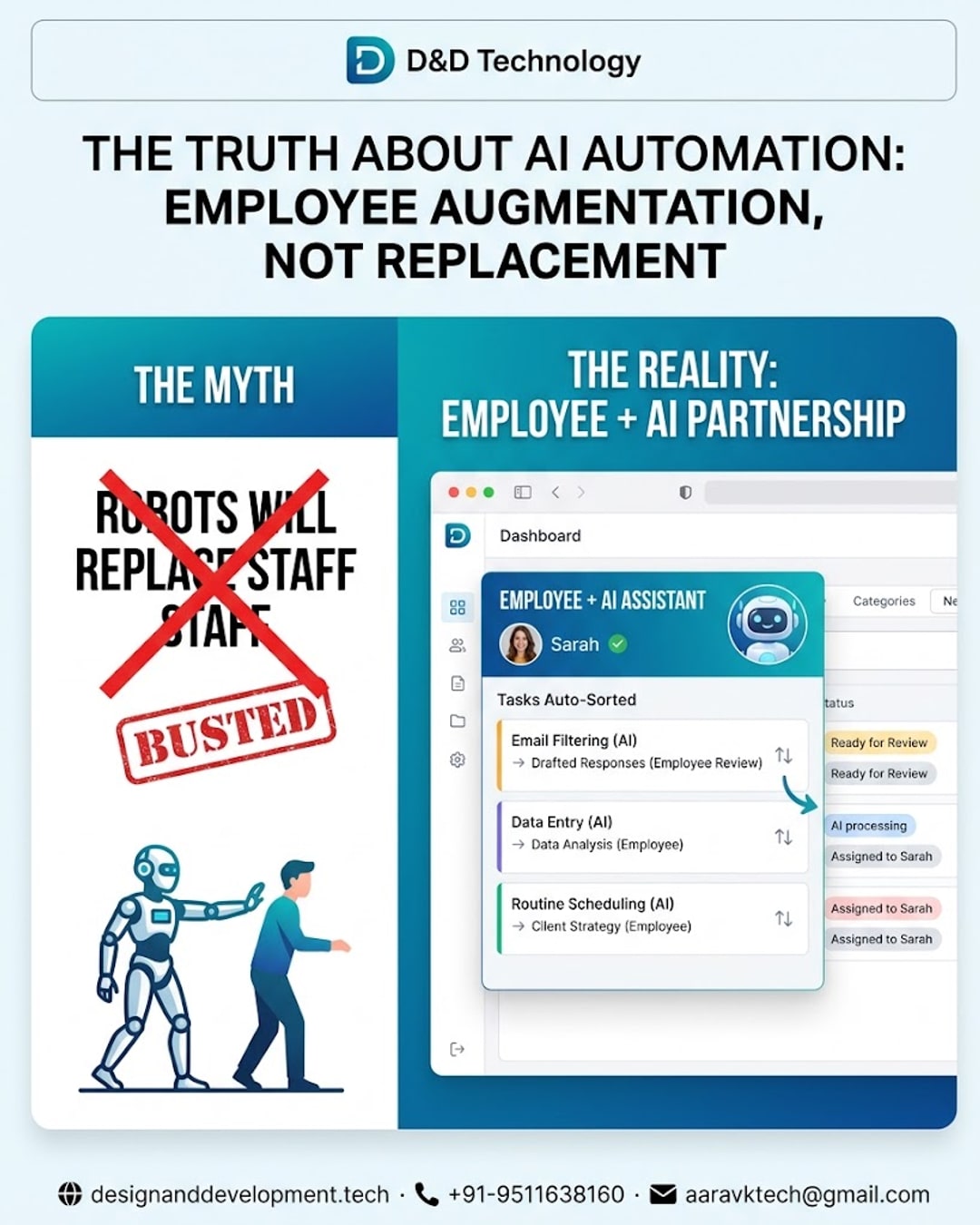
Myth Busted: Does AI Automation Really Replace Your Employees?
If you've ever hesitated to automate parts of your business because you're worried it means cutting jobs, you're not alone. It's one of the most common fears we hear from business owners before they even look at what automation actually does. Here's the truth, and what really happens when a business automates the right way.
Where this myth comes from
Most people picture automation as robots taking over entire departments. In reality, the AI automation used in everyday businesses - lead follow-ups, invoice generation, customer replies, report building - is designed to handle repetitive, rule-based tasks. It's not making judgment calls or managing relationships. That part still needs a human.
What automation actually removes from your team's day
Think about the tasks that eat up hours without needing much thought: copying data between spreadsheets, sending the same follow-up message to ten different leads, manually generating the same report every week. These are exactly the tasks automation is built for. When they're handled automatically, your employees get their time back for things that actually require a person - closing a sale, solving a customer's problem, making a business decision.
Why businesses see more output, not fewer people
In most cases, automation doesn't shrink a team - it lets the same team handle more without burning out. A sales manager who used to spend two hours a day updating a spreadsheet can now spend that time actually talking to leads. A small business owner who used to stay up late generating invoices can now spend that evening with family. The work didn't disappear, it just moved to where it belongs.
What a good automation system looks like
A well-built automation system, like the ones D&D Technology develops, sits alongside your existing team and workflow. It flags what needs a human decision, handles what doesn't, and keeps everything visible on one dashboard. Nobody gets replaced by a dashboard - they just stop wasting time on the parts of their job that never needed a human in the first place.
My take
If you're a small business owner worried that automating a few repetitive tasks means letting people go, that's usually not how it plays out. Start small - automate one repetitive process like lead follow-up or invoice generation - and watch what your team does with the time it frees up. If you're running a growing team that's already stretched thin, automation is often what keeps you from having to hire just to keep up with admin work. Either way, the goal isn't fewer people. It's less wasted time.
🌐 designanddevelopment.in · 📞 +91-7296994920 · 📧 aaravktech@gmail.com


Discussion0