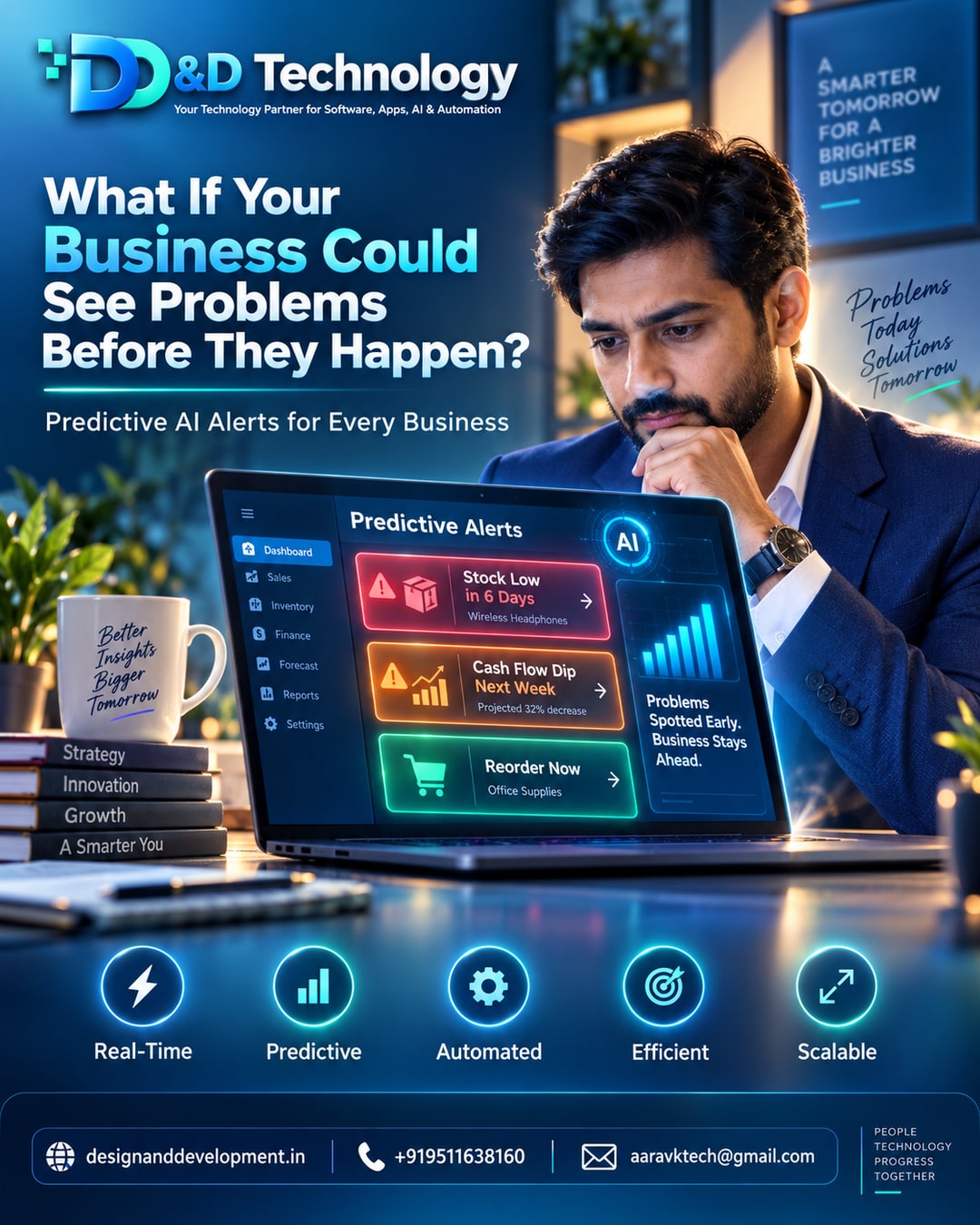
What If Your Business Software Could Warn You Before Trouble Starts?
Most business software today is a rear-view mirror. It tells you what sold yesterday, what's overdue this month, what stock you already ran out of. Useful, but always a step behind. Here's a fair question worth sitting with: what if your systems could look forward instead of backward, and flag problems before they become expensive?
That's the vision behind predictive AI alerts, and it's worth understanding even if you're not building anything yet.
Why reactive software keeps businesses one step behind
A retailer finds out stock ran out only when a customer asks for something that isn't there. A factory owner discovers a machine issue only after production stalls. A founder realizes cash is tight only when a payment bounces. In every case, the information existed earlier — buried in sales trends, machine logs, or invoice patterns — but nothing surfaced it in time.
What predictive alerts could actually look like
Instead of a report you check once a week, imagine a dashboard card that says stock will run out in six days based on current sales velocity. Or one that flags a cash flow dip forming two weeks out, based on pending invoices and upcoming expenses. Or a note that a client's order frequency has quietly dropped, worth a check-in call. None of this is science fiction — it's pattern recognition applied to data your business already generates every day.
Who this future actually helps
It's easy to assume predictive tools are for large enterprises with data science teams. In reality, the businesses that benefit most are the ones running tight margins and small teams — retailers, manufacturers, clinics, service businesses — where one missed signal costs real money and there's no spare person watching for it.
What this means for the software you build today
You don't need predictive alerts on day one. But it's worth building your ERP, CRM or dashboard on a foundation that can grow into this — clean structured data, connected modules, and a system that's actually capable of learning patterns later, rather than a patchwork of disconnected tools that can never see the full picture.
My take: if you're still running on spreadsheets and WhatsApp, don't jump straight to predictive AI — fix the foundation first with a proper connected system, because forecasting needs clean data to work from. But if you already have a working ERP or CRM and it feels purely reactive, it's worth asking your development partner what a predictive layer could look like on top of what you have. The businesses that start asking this question now will be the ones running ahead of it later, not scrambling to catch up.
🌐 designanddevelopment.in · 📞 +91-7296994920 · 📧 aaravktech@gmail.com


Discussion0