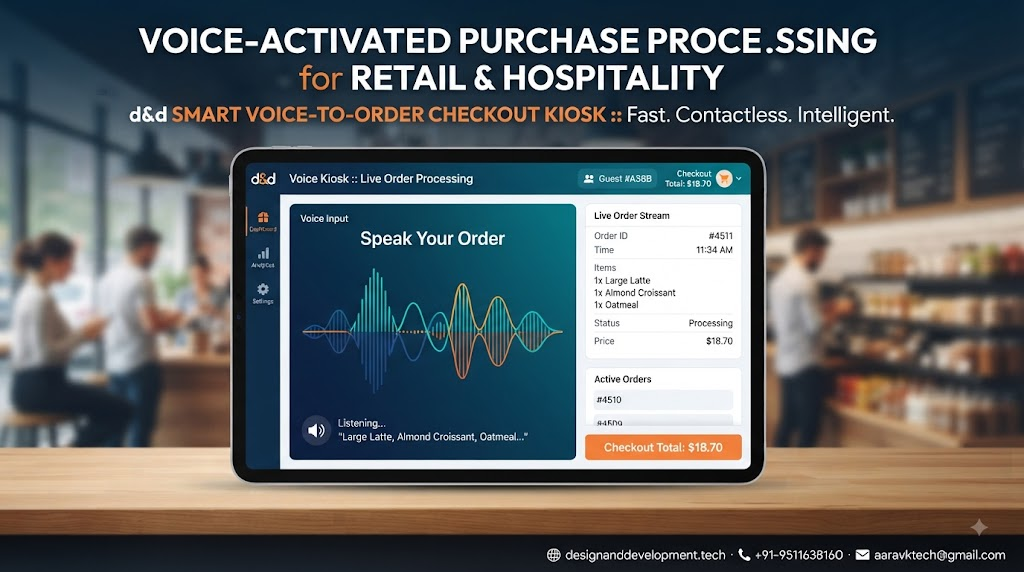
Speed has become the ultimate currency in modern retail and hospitality. When customers walk up to a counter or browse an ordering kiosk, every second of hesitation or manual punch-in increases drop-off rates. Traditional point-of-sale terminals often require staff to click through clunky menus, leading to long queues during peak hours. That is why forward-thinking businesses are turning to voice-activated checkout architecture to streamline transactions. By integrating natural speech recognition directly into ordering workflows, businesses can process checkouts up to three times faster than manual entry.
How Voice-Activated Checkout Works for Everyday Commerce
Implementing voice technology does not require massive hardware overhauls or complex enterprise rollouts. Modern speech-to-text engines, combined with customized business logic, allow an application to listen to an order, parse item names, quantities, and modifiers, and push them directly to a live fulfillment queue. For a busy cafe, retail boutique, or fast-casual food service, this means a cashier or customer can simply state the order out loud, and the system instantly verifies inventory, calculates totals, and routes the ticket to the kitchen or packing station without missing a beat.
The Advantage of Rapid Custom Software Delivery
Many business owners shy away from advanced automation because they believe custom development takes months of costly engineering meetings. However, modern development frameworks allow specialized teams to deploy production-ready systems rapidly. When you work with builders who focus on speed and reliability, custom applications like voice kiosks, inventory dashboards, and automated CRM pipelines can go from concept to live deployment in a matter of days rather than quarters. This eliminates the lag between identifying an operational bottleneck and deploying a permanent fix.
Overcoming Implementation Hurdles in Retail Environments
Deploying new technology in high-traffic environments brings unique challenges, such as background noise interference and staff adoption resistance. To combat ambient noise, modern voice ordering pipelines utilize localized audio filtering and custom vocabulary dictionaries tailored specifically to your menu or product inventory. Furthermore, keeping the user interface clean and intuitive ensures that staff can easily override or manually adjust any voice entry if a customer changes their mind mid-sentence, ensuring zero operational downtime.
My Take on Upgrading Your Checkout Counter
If your business suffers from persistent queue bottlenecks and your current point-of-sale software feels sluggish, waiting around for a traditional software agency to quote a six-month timeline is a losing game. If you want a quick win that immediately boosts throughput and delights customers, investing in a tailored voice-to-order system built within a 48-hour window is well worth it. It gives you an immediate competitive edge without draining your capital on bloated development cycles.
🌐 designanddevelopment.in · 📞 +91-7296994920 · 📧 aaravktech@gmail.com


Discussion0